Why is a group of Crows called a murder?
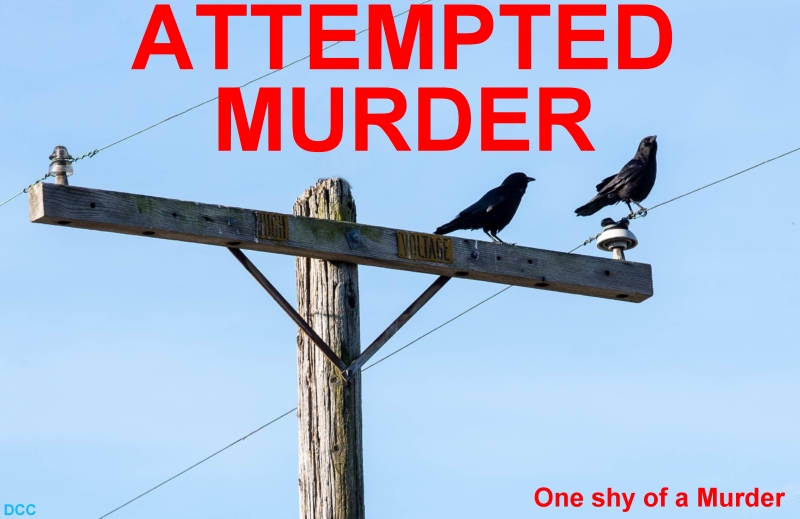
Emerging during medieval times, and popularized by the nobility, many collective nouns are poetic and colorful in nature. Based on old folk tales, superstitions, and mythology, there are likely several different explanations for the origin of the term ‘murder of crows’.
A Murder seems especially fitting for the behavior crows to display when a death occurs amongst their number. Very few animals have what is known as a grieving ritual, other than humans, of course, so the behavior of “holding a funeral” that is sometimes observed in crows is particularly intriguing. Crows flock to members of their own species after death and may interact with the dead bird in a variety of ways. Although the behavior may look like mourning, scientists believe it serves other purposes as well. Crows are incredibly intelligent and maybe trying to learn from the situation at hand, trying to ascertain both what may have befallen their comrade. By sticking close to a crow that was killed, other crows may improve their chances of learning about predators they need to avoid.
Human rituals for dealing with the dead are numerous and varied. But animals in the wild are not widely known to behave in an unusual way when confronting a dead animal of their own species. In fact, the researchers said in the study, “few animals have been reported to show more than a passing interest.” African elephants will touch, groom, or otherwise attend to a dead elephant, and scientists have noted similar behavior in bottlenose dolphins, chimpanzees, and certain species of jays and magpies.
Most people would call it a Flock of Crows. One could think of a murder of Crows to be the “poetic term”. The word for this grouping appears in the title of the short story “Murders in the Rue Morgue” is a well-known short story by Edgar Allan Poe.
This is all thanks to the “collective noun”. In fact, a murder is not the only collective noun for a group of crows.
A “convocation” of Eagles
A “charm” of hummingbirds.
A “skulk” of foxes.
A “chattering” of starlings.
A “mustering” of storks.
An “unkindness” of ravens.
A “siege” of herons.
A “leap” of leopards.
A “murder” of crows.
A “sloth” of bears.
It can even get worse!
If the group of geese is flying, it becomes a “skein”. If the geese are on the water, they’re a “gaggle”.
I would say if you saw a group of crows and you said look at the Flock of crows 99.9% of the people around you would not correct you. It is also odd that it is a murder of Crows but the ravens are only an unkindness. After all Ravens are the larger birds. Go figure!
You’ve Heard of a Murder of Crows. How About a Crow Funeral?
They may be dressed in black, but crow funerals aren’t the solemn events that we hold for our dead. These birds cause a ruckus around their fallen friend. Are they just scared, or is there something deeper going on? It’s a common site in many parks and backyards: Crows squawking. But groups of the noisy blackbirds may not just be raising a fuss, scientists say. They may be holding a funeral.
Kaeli Swift, a Ph.D. candidate at the University of Washington’s Avian Conservation Lab in Seattle, is studying how crows learn about danger from each other and how they respond to seeing one of their own who has died. Unlike the majority of animals, crows react strongly to seeing a fellow member of their species has died, mobbing together and raising a ruckus.
Only a few animals like whales, elephants and some primates, have such strong reactions. To study exactly what may be going on, Swift developed an experiment that involved exposing local crows in Seattle neighborhoods to a dead taxidermied crow in order to study their reaction. “It’s really incredible,” she said. “They’re all around in the trees just staring at you and screaming at you.”
Swift calls these events ‘crow funerals’ and they are the focus of her research.
— What do crows eat?
Crows are omnivores so they’ll eat just about anything. In the wild they eat insects, carrion, eggs seeds and fruit. Crows that live around humans eat garbage.
— What’s the difference between crows and ravens?
American crows and common ravens may look similar but ravens are larger with a more robust beak. When in flight, crow tail feathers are approximately the same length. Raven tail feathers spread out and look like a fan. Ravens also tend to emit a croaking sound compared to the caw of a crow. Ravens also tend to travel in pairs while crows tend to flock together in larger groups. Raven will sometimes prey on crows.
— Why do crows chase hawks?
Crows, like animals whose young are preyed upon, mob together and harass dangerous predators like hawks in order to exclude them from an area and protect their offspring. Mobbing also teaches new generations of crows to identify predators.